Rethinking the Footprint: How Florida Companies Are Reimagining Office Space for a Hybrid Workforce

Photo by Photo by George Pagan III on Unsplash on Unsplash
A Permanent Shift, Not a Temporary Adjustment
For a period following 2020, many Florida business leaders operated under the assumption that workplace disruption was a temporary condition — a detour from which the traditional office model would eventually recover. That assumption has not aged well. Across Miami, Tampa, Orlando, Jacksonville, and the state's many mid-sized markets, companies are now confronting a more durable reality: the relationship between employees and physical workspace has fundamentally changed, and designing around that change is no longer optional.
The hybrid workforce model — in which employees divide their time between remote locations and a shared office — is now the dominant arrangement across professional services, technology, finance, and many other sectors. For Florida employers, this shift raises a set of interlocking questions that are simultaneously strategic and spatial. How much commercial square footage does a company actually need when only a fraction of its team is present on any given day? What should that space accomplish that remote work cannot? And where should it be located to remain relevant to a workforce whose geography is no longer anchored to a daily commute?
These are not merely real estate questions. They are organizational design questions, and they demand a correspondingly rigorous framework.
The Downsizing Trap
The most reflexive response to hybrid work adoption is lease reduction. If fewer people are in the office, the logic goes, less space is required, and reducing square footage translates directly to lower occupancy costs. This reasoning is not wrong, but it is dangerously incomplete when applied without strategic context.
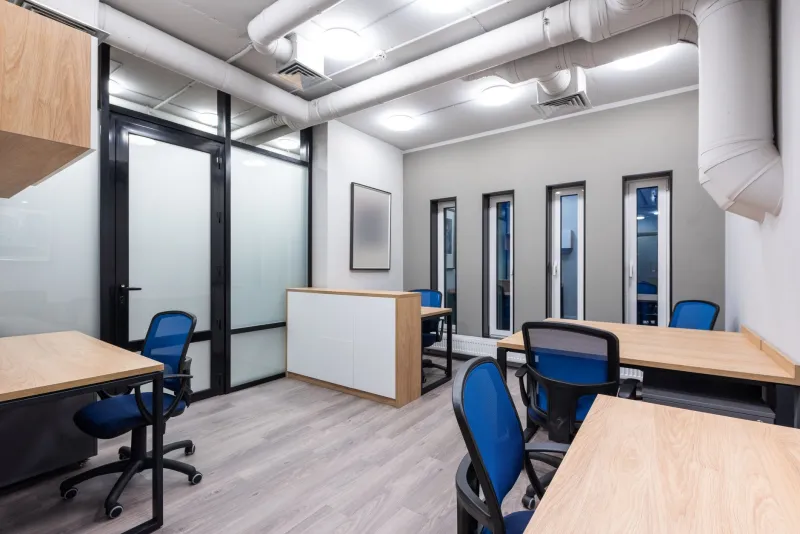
Companies that downsize without redesigning risk creating spaces that serve neither remote-first nor in-office employees particularly well. A smaller version of a traditional office — rows of underutilized assigned desks in a reduced footprint — does not solve the fundamental challenge. It simply makes the problem cheaper and more compact.
The more productive question is not how much space can be eliminated, but what the remaining space must accomplish. When remote work handles the majority of individual, focused tasks, the office's primary value proposition shifts. It becomes a venue for collaboration, culture reinforcement, mentorship, and the kind of spontaneous interpersonal exchange that distributed work cannot replicate. Designing for that purpose requires a fundamentally different spatial logic than the traditional workstation-centric floor plan.
Designing for Presence, Not Occupancy
Leading workspace designers and commercial architects working across Florida's major markets are increasingly drawing a distinction between designing for occupancy — maximizing the number of people a space can hold — and designing for presence — maximizing the quality of experience for those who choose to be there.
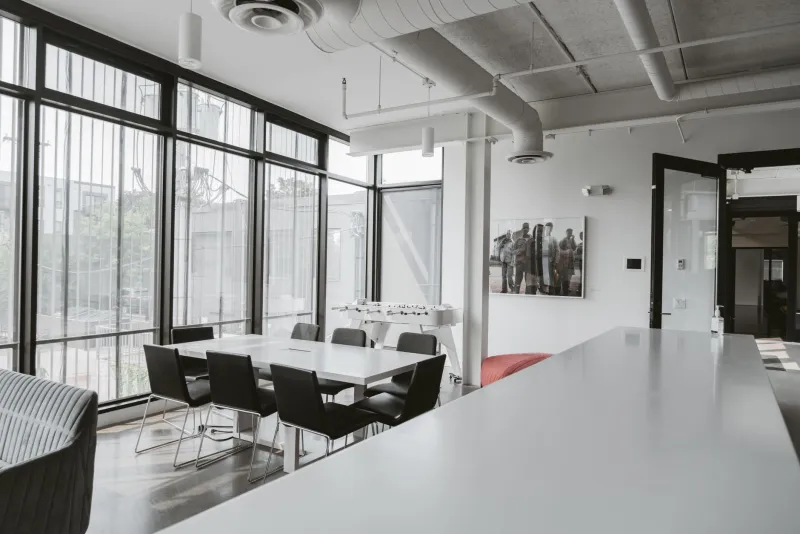
In practical terms, this means prioritizing collaborative zones over individual workstations, investing in acoustic design that supports both focused conversation and group discussion, and creating environments that offer a demonstrably better experience than a home office. The last point is particularly significant. In a market where employees have genuine choice about where they work, the physical office must compete for their voluntary presence. A space that offers nothing beyond a desk and a conference room will lose that competition consistently.
This calculus plays out differently across Florida's varied commercial markets. In Miami's Brickell and Wynwood corridors, where design-forward aesthetics carry significant talent signaling value, workspace investment is often a direct recruiting tool. In Tampa's rapidly expanding business districts, proximity to transit infrastructure and walkable amenities is increasingly a factor in where companies choose to locate their reduced-but-reimagined footprints. In smaller markets like Sarasota or Gainesville, cost efficiency and local talent retention often drive different prioritization entirely.
Location Strategy in a Distributed World
The question of where to locate office space has also grown more complex. When daily commuting was the norm, office location was largely determined by accessibility from residential areas and proximity to clients. In a hybrid model, those criteria do not disappear, but they are weighted differently.
Some Florida companies are finding strategic value in maintaining a smaller, centrally located presence in a major market while allowing the majority of their team to work remotely from across the state or beyond. This approach can dramatically reduce real estate costs while preserving the cultural and operational benefits of periodic in-person gathering. Others are moving toward hub-and-spoke models, with a primary office supplemented by smaller satellite spaces closer to where distributed team members actually live.
For companies competing for talent in high-demand sectors — technology, healthcare consulting, financial services — location decisions carry additional weight. Florida's population growth has created competitive labor markets in cities that were once considered secondary. A company whose office is inconveniently located for the demographic it needs to attract may find that its physical footprint is working against its hiring strategy.
Practical Principles for Hybrid Workspace Design
For Florida business leaders currently navigating lease renewals, relocations, or office redesigns, several principles have emerged as reliable guides.
Right-size through role analysis, not headcount reduction. Begin by mapping which functions genuinely benefit from in-person proximity and which are equally or better served remotely. Let that analysis determine your spatial program rather than applying a blanket percentage reduction.
Invest disproportionately in collaboration infrastructure. Video conferencing technology, acoustic privacy, flexible furniture configurations, and high-quality shared amenities deliver outsized returns in hybrid environments where the office's primary function is bringing people together effectively.
Treat the office as a brand asset. The physical workspace communicates organizational values to both employees and clients. A thoughtfully designed, well-maintained environment signals investment in people and culture. A neglected or generic space signals the opposite.
Build flexibility into your lease terms. The pace of change in workplace norms has not stabilized. Negotiating shorter initial terms, renewal options, and expansion or contraction rights preserves strategic flexibility as your understanding of your team's needs evolves.
The Strategic Office
The office of the future in Florida is not a smaller version of the office of the past. It is a purpose-built environment designed around a clear understanding of what in-person work uniquely provides and what it costs to provide it well. Companies that approach this design challenge with the same strategic rigor they bring to their financial or operational planning will find that their physical footprint becomes a genuine competitive asset. Those that treat it as a line item to be minimized may find that the space they saved cost them more than they anticipated — in talent, in culture, and in organizational cohesion.