The Silent Resignation: How Poorly Designed Workplaces Are Handing Florida's Best Employees to the Competition
There is a particular kind of departure that Florida business leaders rarely see coming. It does not announce itself through salary negotiations or formal grievances. It arrives quietly, in the form of a resignation letter from an employee who, by every measurable standard, appeared engaged. The exit interview, if conducted honestly, often reveals something that compensation adjustments cannot fix: the environment itself communicated a lack of belief in the future.
This is the talent exodus trap — and it is far more prevalent across Florida's commercial landscape than most executives are prepared to acknowledge.
What High-Performers Actually Read Into a Workspace
Top-tier employees possess a skill that distinguishes them from average performers: they evaluate systems, not just tasks. When they walk into a workspace each morning, they are unconsciously auditing the organization's operational philosophy. Frayed conference room chairs, inconsistent lighting, acoustically chaotic open floors, and technology infrastructure that requires workarounds — each of these details registers not as inconvenience, but as institutional indifference.
In Florida's competitive hiring environment, where technology, finance, healthcare, and professional services firms are expanding rapidly across Tampa, Miami, Orlando, and Jacksonville, the physical workplace has become a competitive differentiator that many business leaders still underestimate. A high-performing employee receiving a recruiter inquiry from a competitor with a thoughtfully designed headquarters is not weighing salary alone. They are weighing futures.
The workspace is a three-dimensional business strategy document. It communicates whether leadership thinks long-term or reacts short-term. It signals whether growth is anticipated or feared. And it tells employees, with remarkable clarity, whether they are considered assets or overhead.
The Operational Signals That Accelerate Departure
Several specific design and operational choices consistently appear in organizations experiencing disproportionate turnover among high-performers. Understanding them is the first step toward reversal.
Spatial stagnation. When a company's physical footprint has not evolved in years — same layout, same furniture, same workflow bottlenecks — it signals organizational inertia. High-performers, who are acutely attuned to growth trajectories, interpret an unchanging environment as evidence that leadership has stopped investing in the future.
Collaboration infrastructure that impedes rather than enables. Poorly designed meeting spaces, inadequate acoustic separation, and insufficient private focus areas force employees to fight their environment to do their best work. The frustration this generates is cumulative, and it disproportionately affects the employees who care most about the quality of their output.
Misalignment between stated culture and physical reality. When a company publicly promotes innovation, flexibility, or employee wellbeing, but the workspace reflects none of those values, high-performers experience a credibility gap. That gap erodes trust in leadership far more broadly than most executives realize.
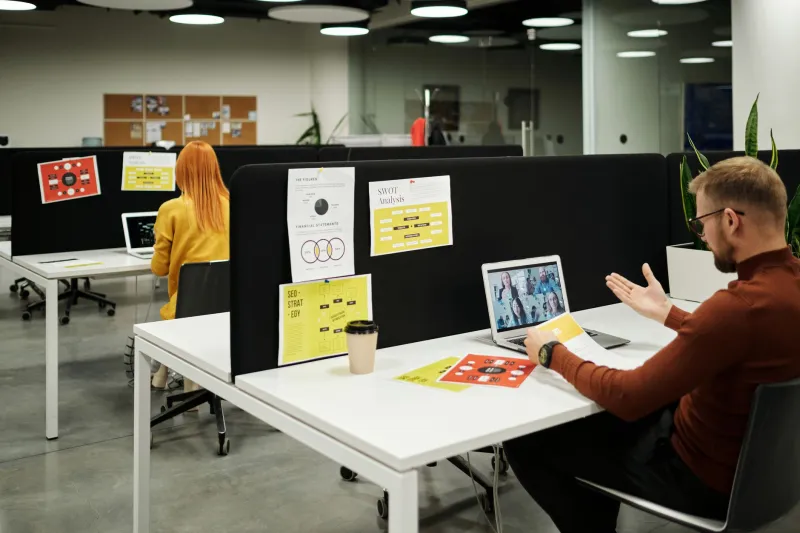
Technology as an afterthought. In an era when hybrid work has become standard across Florida's professional sectors, organizations that have not integrated technology seamlessly into their physical design create friction at every interaction point. For employees accustomed to high-functioning environments, this friction reads as a structural failure, not a temporary inconvenience.
Case Studies in Reversal: What Restructuring Actually Looks Like
Several Florida-based organizations have confronted this pattern directly and restructured accordingly — with measurable results.
A mid-sized professional services firm in the Tampa Bay area was experiencing annual turnover among its senior-level staff that consistently exceeded industry benchmarks. Exit interviews pointed vaguely to "better opportunities," but a more granular analysis revealed that departing employees were consistently moving to firms with newer, more intentionally designed office environments. Rather than respond with compensation increases alone, the firm undertook a comprehensive workspace redesign that prioritized acoustic zoning, flexible collaboration spaces, and a technology infrastructure capable of supporting seamless hybrid workflows. Within eighteen months of implementation, senior-level retention improved significantly, and the firm reported a measurable uptick in internal promotion rates — a signal that high-performers were now viewing the organization as a place with a future worth pursuing.
A growing healthcare administration company in the Orlando metro faced a similar pattern but with an additional layer of complexity: their physical environment had not kept pace with their headcount growth, resulting in overcrowded, poorly organized workspaces that communicated chaos rather than scale. Working with a strategic design partner, they reimagined their footprint entirely — creating tiered work zones aligned with different types of cognitive work, incorporating natural light more deliberately, and establishing clear visual and physical markers of the company's growth trajectory. The redesign was paired with a documented strategic growth plan that was made visible to employees throughout the space. Turnover among high-performers dropped substantially in the year following implementation.
In both cases, the common thread was not a single dramatic intervention. It was the cumulative effect of demonstrating, through physical and operational design, that leadership was actively investing in the organization's future.
Retention Is a Design Discipline
The framing of employee retention as primarily an HR or compensation challenge has led many Florida businesses to apply the wrong solutions to a structural problem. Perks — catered lunches, wellness stipends, flexible scheduling — are not irrelevant, but they function as surface-level responses to a deeper organizational signal. When the underlying environment communicates stagnation, perks register as compensation for a deficiency rather than expressions of genuine investment.
Retention, at its most durable, is an architectural outcome. It is the result of deliberate decisions about how space communicates organizational values, how workflow design respects employee cognition, and how the physical environment aligns with the strategic ambitions leadership communicates verbally.
For Florida businesses competing for talent in an increasingly mobile professional landscape — where a high-performer in Jacksonville can accept a remote role with a Miami-based firm without relocating — the stakes of this alignment have never been higher.
Building an Environment That Earns Loyalty
The practical path forward begins with an honest audit of what the current workspace communicates. Not what leadership intends it to communicate — what employees actually experience within it. This distinction is critical, and it requires a perspective that is external to the organization's internal assumptions.
From that audit, strategic workspace redesign should address three foundational questions. First, does the physical environment reflect the company's actual growth trajectory, or does it reflect where the company was three years ago? Second, does the workspace enable the type of high-quality work that high-performers need to do in order to feel professionally fulfilled? Third, is there visible evidence — spatial, operational, and strategic — that leadership is making deliberate investments in the organization's future?
When the answers to those questions are affirmative, the workplace stops functioning as a liability in the talent competition and begins functioning as a recruitment and retention asset.
The Blueprint Imperative
Florida's business landscape is characterized by rapid growth, intense competition for skilled professionals, and a geographic diversity that demands locally attuned strategy. In this context, the companies that will sustain competitive advantage are not necessarily those that offer the most aggressive compensation packages. They are the ones that build environments — physical and operational — that demonstrate a coherent, ambitious, and investable future.
The talent exodus trap is not inevitable. It is a design problem. And design problems, by definition, have design solutions. The question is whether Florida's business leaders are prepared to treat the workplace not as a cost center to be minimized, but as a strategic instrument to be refined — one that speaks, every single day, on behalf of the organization's commitment to its people and its future.