Built Around One Person: Why Founder-Centric Operations Become Florida Companies' Greatest Growth Constraint
Let's be direct about something that rarely gets said plainly in business consulting circles: the person who built your company may also be the primary reason it cannot grow beyond a certain point.
This is not a criticism of entrepreneurial talent. Florida's business landscape is full of founders who are genuinely exceptional—people with sharp instincts, deep market knowledge, and an extraordinary capacity for getting things done under pressure. The problem is not their capability. The problem is what happens when that capability becomes the operational center of gravity for an entire organization.
When a business is built around one person's way of working, it does not scale. It replicates—imperfectly, incompletely, and with increasing strain—until the seams begin to show.
The Architecture of Habit
Every founder develops a personal operating system over the course of building their business. It is assembled from experience, instinct, and necessity—a combination of workflows, decision rules, communication preferences, and informal knowledge that allows them to move quickly and effectively through complex situations.
In the early stages, this personal operating system is an asset. A small team can orbit around one person's judgment without significant structural cost. Decisions get made quickly. Information flows informally. The founder's presence fills the gaps that formal processes have not yet been built to address.
The difficulty arises when the company grows and the founder's personal operating system—never designed for replication—begins to function as the de facto organizational infrastructure. Processes that exist only in the founder's head cannot be delegated. Decisions that require the founder's contextual knowledge cannot be made without them. A culture of informal communication that works at ten employees becomes a bottleneck at forty.
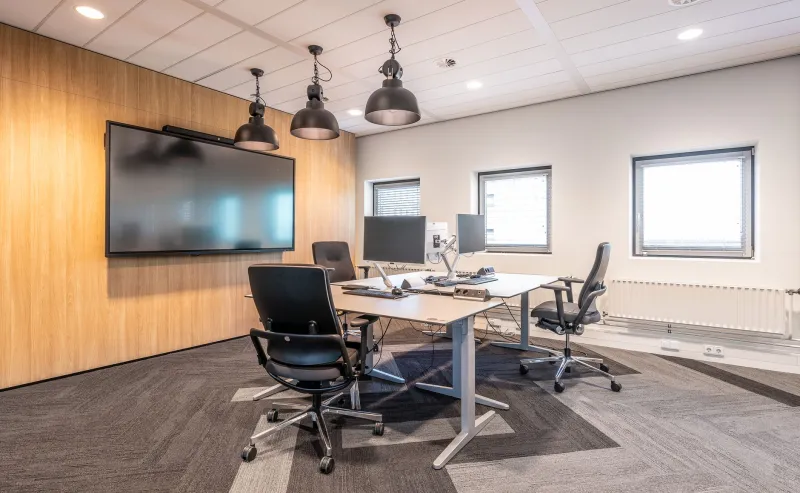
The physical workspace often reflects this dynamic as well. In many founder-led Florida businesses, the office layout, the flow of foot traffic, and the informal gathering points have all evolved organically around the founder's presence and preferences—rather than around the collaborative needs of the broader team. The workspace, in this sense, is as founder-centric as the operational structure itself.
What Delegation Actually Requires
Founders frequently describe their inability to delegate as a matter of trust or talent—they cannot find people capable of doing things the way they need to be done. This diagnosis, while understandable, is usually incomplete.
Effective delegation is not primarily a personnel challenge. It is a documentation and design challenge. When processes exist only as institutional knowledge residing in a single person's mind, there is nothing concrete to delegate. A capable employee placed into an undocumented, founder-dependent workflow will struggle not because they lack ability, but because the system they have been handed was never designed to be operated by anyone other than its creator.
This is the structural trap at the heart of founder-centric operations. The founder interprets the employee's difficulty as evidence that delegation is not viable. The employee interprets the founder's continued involvement as evidence that they are not trusted. Both parties are responding rationally to a design failure that neither of them created and neither of them has named.
The Compounding Cost of Operational Dependency
The costs of founder-centric operations are not always immediately visible, but they compound significantly over time. The most obvious cost is the founder's own capacity: when every significant decision requires their involvement, and every non-standard situation escalates to them, their time becomes the scarcest resource in the organization. Growth is effectively capped at the volume of work one person can personally oversee.
Less visible, but equally significant, is the cost to employee engagement and retention. Talented people who join a growing Florida company with the expectation of meaningful responsibility—and then find themselves working within a system that consistently routes authority back to one person—do not stay. The frustration of operating without genuine decision-making power is not offset by competitive salaries or appealing perks. It is a structural experience, and it produces structural disengagement.
There is also the strategic cost of a leadership team that has never been required to develop independent judgment. When founders maintain operational centrality for too long, the people around them develop expertise in execution—but not in thinking. The organization becomes capable of implementing decisions but poorly equipped to make them, which is a critical vulnerability at precisely the moment when growth demands more distributed strategic capacity.
Rebuilding the Blueprint Without the Founder at the Center
The work of transitioning from a founder-centric operation to a scalable organizational design is not comfortable. It requires founders to examine their own workflows with the same critical objectivity they would apply to any other business problem—and to accept that some of what has made them effective is also what is holding the company back.
The practical starting point is documentation. Every process that currently exists in the founder's head—every informal decision rule, every exception-handling approach, every communication preference—needs to be made explicit. This is not about creating bureaucratic procedure manuals. It is about externalizing institutional knowledge so that it can be evaluated, refined, and ultimately operated by people other than its originator.
From there, the work is redesign. Which of these processes, once documented, reveal themselves as unnecessarily complex or idiosyncratic? Which decision thresholds can be formally delegated without requiring founder involvement? Which communication patterns need structural support—whether through defined meeting cadences, clearer reporting lines, or a workspace layout that facilitates the right kinds of informal exchange without depending on the founder's physical presence?
This is, in essence, the work of building a company that functions as a system rather than as an extension of a single person. It is harder than it sounds, and it requires the founder to tolerate a period of reduced control in exchange for the long-term capacity that genuine scalability demands.
A Different Kind of Blueprint
The most successful Florida founders we encounter are not those who have avoided building founder-centric organizations—almost every entrepreneurial business goes through that phase. They are the ones who recognized the pattern early enough to redesign around it.
They made the transition from being the operational center of their company to being its strategic architect. They built processes that could run without them, teams that could decide without them, and workspaces that supported collaboration rather than dependence. In doing so, they created organizations that could grow beyond the ceiling of any one person's capacity.
That transition is not a loss of control. It is the most important investment a founder can make in the long-term viability of what they have built.